
Seeds
literal and figurative
I should have known better. Every time I tell myself the post I’m writing is simple and I should be able to knock it out, I discover how complex the subject truly is. I’m working on the second part of my series on anxiety, looking at professionalism and anxiety in the workplace. I’ve discovered more than I expected and now I need to sift and cut it back.
In the meantime, I thought I’d share a few things:
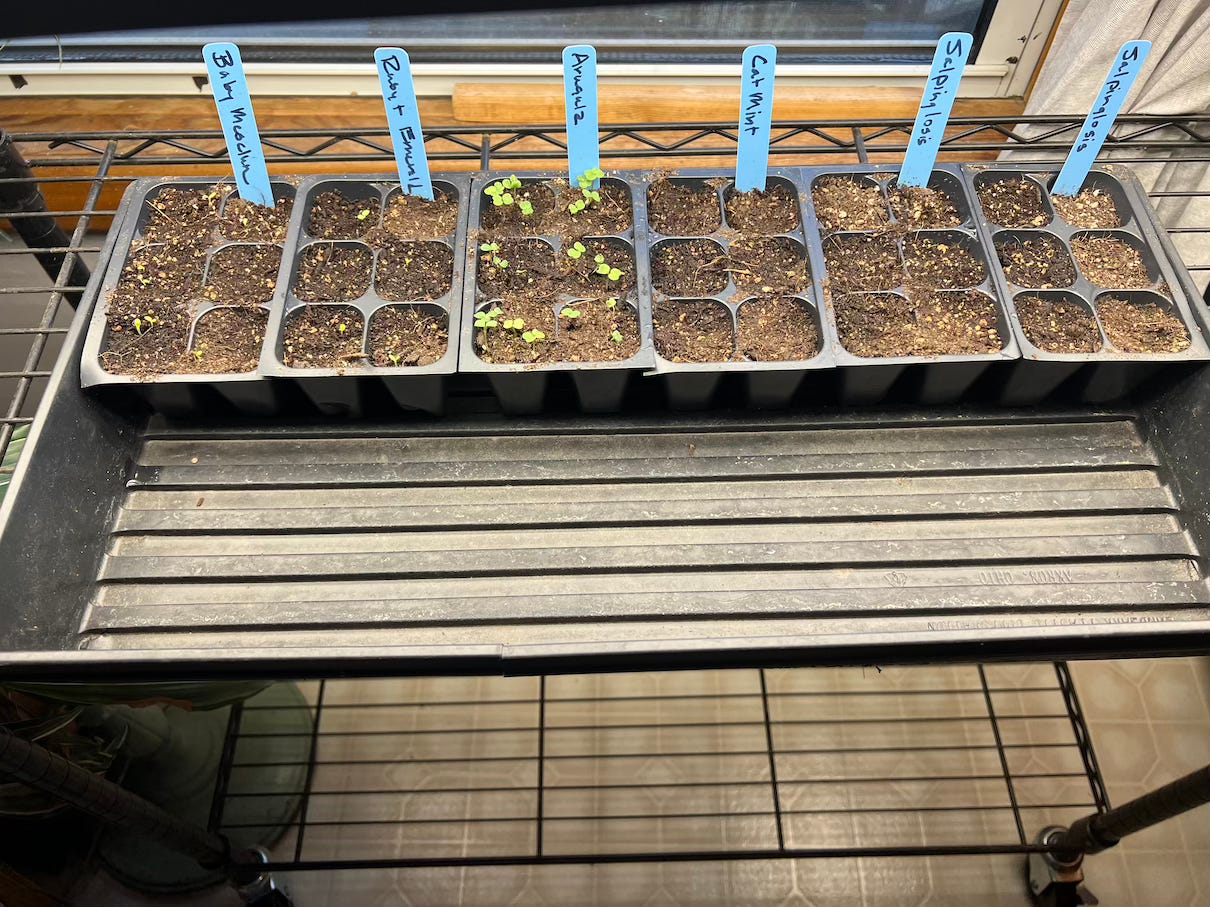
—After several years of not having time to start seeds, I’m back at it. My first little sprouts came up this week (pic above). I forget what it’s like to come down every morning and see something growing . My favorite part is watching a green speck heave a tile of dirt out of its path. It’s a kitchen version of Alyssa Liu’s decision to do things her own way.
We’ve had a weird winter/non-winter here in Portland, with not enough snow on Mt. Hood and the ski season canceled across the West. Though having a bit of sunshine in February has been nice, it also feels unnerving, because we need lots of water here in the winter to stave off the threat of fire in the summer. I keep delaying pruning my roses because I’m waiting for a hard frost, and now it’s almost March so I’m going to be cutting back rose canes that have new leaves on them and feeling like I’m inflicting harm.
—I pulled together some books on solidarity and I’m reading them as I have time:
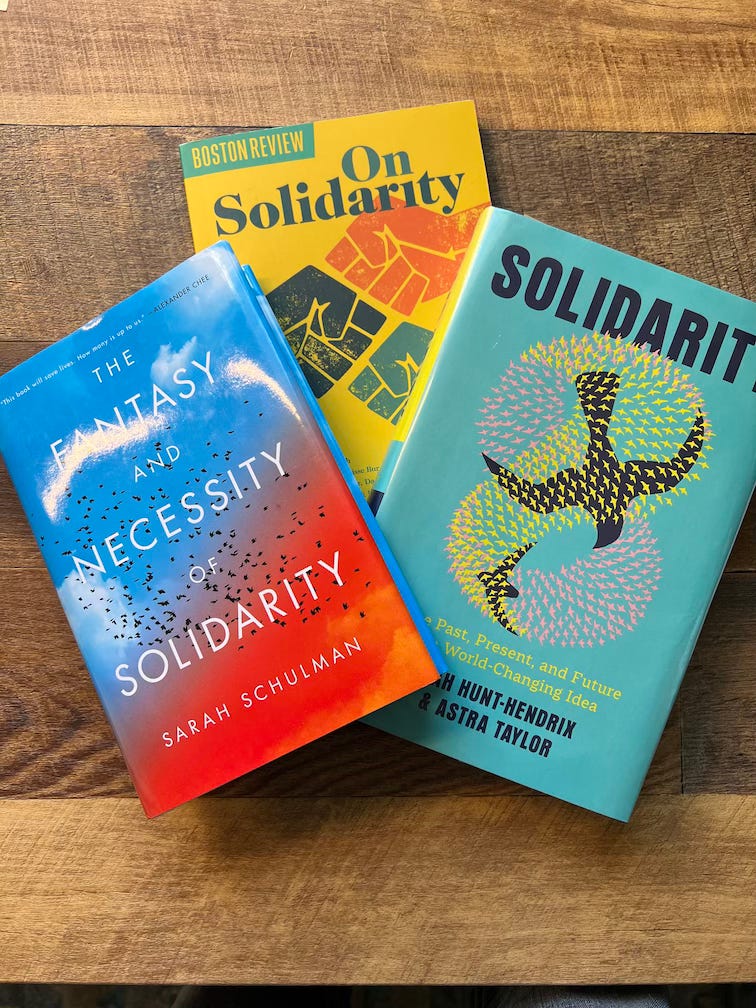
I’ve wanted to dig into this idea for several years, but the situation in Minneapolis—and now the surrounding towns—made me even more eager to understand the history of solidarity and how it’s being used in different contexts today.
I’ve heard from a number of people that folks in Minneapolis pulled together and didn’t get waylaid by theoretical or political differences from each other because it was so obvious what had to be done. That made me wonder about the difference between solidarity forged in response to a direct, violent threat and solidarity forged in anticipation of a threat. If there’s no clear sense of when that threat might arrive, and how much time you have to prepare, does this ambiguity make solidarity harder to achieve?
I’ve also been thinking about the block-by-block organizing strategy that kept Minneapolis decentralized and flexible. It’s a humbling reminder to me that even though I know some people on my block pretty well, others are strangers to me. I’d love to learn what they need, what they’re good at, what they have to give and what they’d be open to receive from others. It’s such a simple set of questions, and yet I feel shy at the thought of just knocking on someone’s door and saying hello and taking the first steps that would get me to a place where I could ask those questions without seeming invasive.
I know what I’m describing here is more mutual aid than solidarity, but that’s in part why I’m learning about solidarity—to understand if mutual aid can build solidarity, or if solidarity leads to mutual aid happening organically, or if the two tactics orbit each other but don’t necessarily connect.
—Lastly, I’ve been trying for weeks now to discover what it is specifically that ICE recruits are being told about the “other,” however that other is being construed. I’ve found information about the training as a whole, and how many hours are being cut, and what sections of training have been eliminated. But I still can’t find anything about what new ICE employees are being told is the larger “why” they’re in our cities and why it’s so crucial to eliminate this threat, either through deportation, locking people up, or murdering them. (So if you know anything about this, please let me know.)
As I’ve been trying to answer this question, I’ve been rummaging around in German sociologist Helmut Rosa’s doorstop of a book Resonance. He has this to say about adolescents who are abused in their families and who then become violent in response:
By committing violence themselves, these youths overcome and conquer their vulnerability and experience of powerlessness. . . . The perpetrator of violence who strikes is not harmed but does harm. He himself tortures, destroys, annihilates, and thus compensates for his experience of repulsion. What he is not able to do, however, is establish a resonant relationship. His relationship to the world remains repulsive. The polarity of the repulsion is merely reversed: it proceeds no longer from the world, but from the subject. The perpetrator now pre-empts the hostile world.
The victim is now perceived as being utterly at the mercy of the perpetrator, and in the act of violence, the subject may also become completely insensitive both to his own physical pain and to other, psychological impulses. The exercise of violence can thus take on intoxicating, orgiastic features — the experience of impotence is transformed into an experience of omnipotence. But this form of relating to the world lacks everything that characterizes a resonant relationship. The subject who commits violence closes himself off from the Other. He does not want to perceive the Other’s “own voice” as a voice that concerns him in some way, but at most wants to hear the pained screams of submission to his own will. He does not reach out to the Other in a dialogic sense, but aims only at annihilation and control, at instrumental self-efficacy. (448-449)
I’d already been wondering about the backstory of so many of these ICE recruits, and I was struck by the way the description provided by Rosa matched what I’ve felt as I read about or watched ICE agents congratulate each other in public as they’re inflicting violence. I don’t want to simplify what’s happening or speculate about the family histories of what is certainly a varied and complex group of people.
I’m offering this passage, rather, because it offers a way of interpreting what ICE agents are doing that supplements the arguments that ICE recruits are acting purely out of training, or pre-existing white nationalism, or successful propaganda about threats to the viability of the nation state.
Alright—that’s it for me. I’m putting these seeds of ideas and questions out here in part to see if you have thoughts about them, too, or suggestions for learning more about any of these topics, or things you’re doing out there in the world, so please chime in if you have stuff to share.
Hope you are all having a good week. Bye for now!
More salient words Rebecca, thank you.
That passage from Rosa speaks so clearly to a societal/systemic level as well as the individual. The deep intergenerational trauma of the colonised acted out violently as coloniser / oppressor, all the way up to the level of nation state. A cycle we so urgently need to break. Though I am supposing this can only be done at an individual, relational level.